 Inference
 Marketplace


Introduction
This case study illustrates how a distributed industrial organization uses ZEDEDA Edge Infrastructure Services to manage edge computing infrastructure at scale. It uses a hypothetical company called Grid-Connect to walk through the platform’s core concepts in a real-world context.About Grid-Connect
Grid-Connect is a wind turbine manufacturer with wind farms across the United States. Each farm contains hundreds of turbines in remote, geographically distributed locations. Their most important business assets — the turbines themselves — require secure, reliable remote management. On-site IT expertise is not available at these locations. Grid-Connect uses Edge Infrastructure Services to increase the security and reliability of their turbine management. Their IT department repurposes existing industrial PCs by installing EVE-OS (Edge Virtualization Engine) on them, then uses existing networks to onboard and manage the devices as nodes.Architecture Overview
The following diagram shows how Grid-Connect uses Edge Infrastructure Services to orchestrate all their nodes across their wind farms.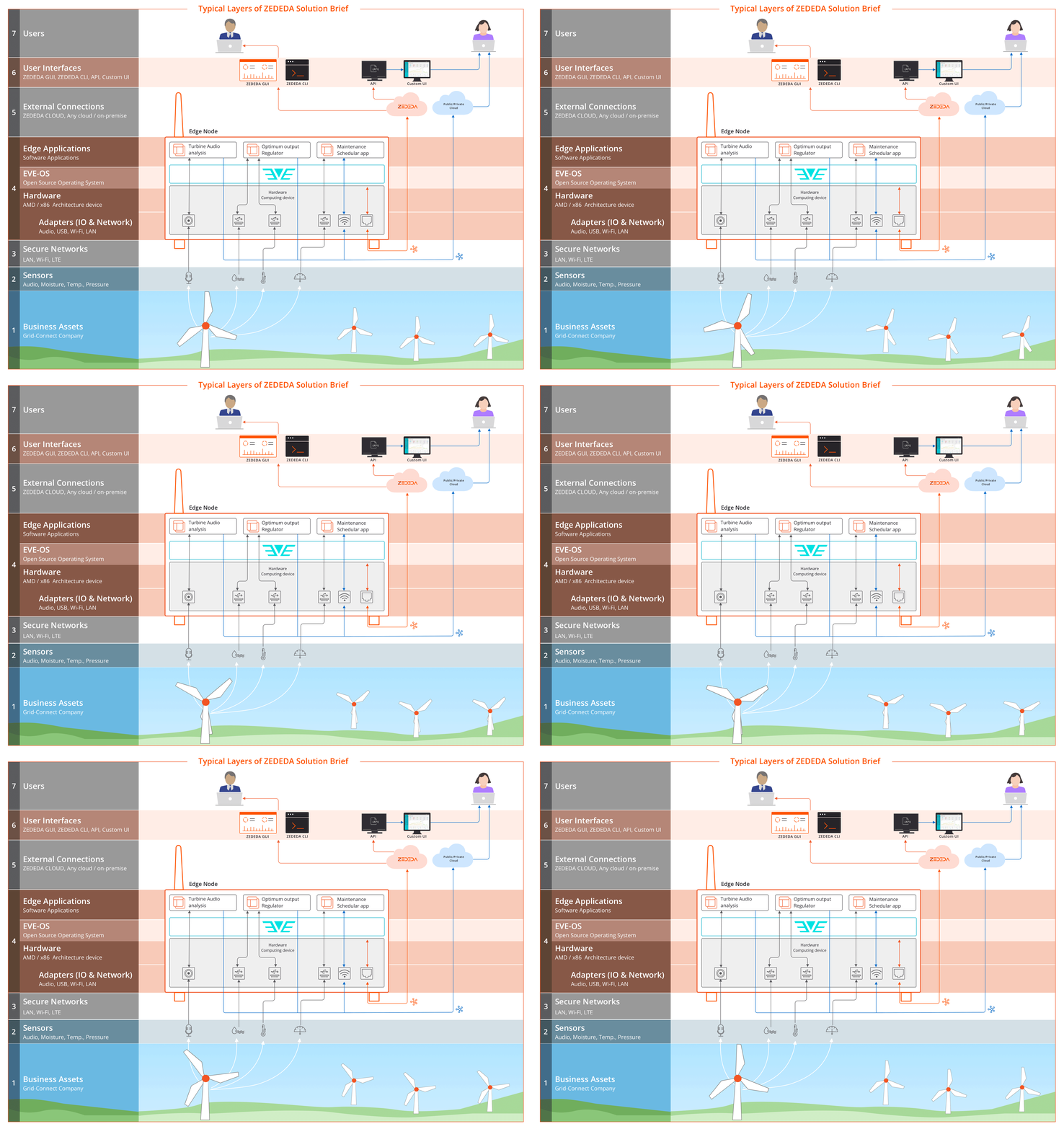
- A turbine audio analysis application that records sound near the turbine shaft, processes it with machine learning algorithms, and predicts maintenance needs.
- An optimum output regulator that measures environmental parameters and adjusts turbine controls to maximize energy output.
- A maintenance scheduler that collects sensor data and generates optimized maintenance schedules.
Platform Usage
Grid-Connect uses both the console GUI and ZCLI to manage their fleet:- Projects: IT administrators create projects for each wind farm, grouping hundreds of nodes by geography. User roles are scoped to these projects, so administrators responsible for a specific farm can only access assets within their region.
- Users and roles: Role-based access control allows Grid-Connect to segment their team by responsibility. Application developers use the console to explore the Marketplace. Operations teams use ZCLI and the API to script routine provisioning and management tasks.
- Automation: ZCLI and the ZEDEDA API allow Grid-Connect to script onboarding, application deployment, and monitoring at scale — without requiring on-site expertise at any of their remote locations.
Key Takeaways
This deployment illustrates several characteristics of Edge Infrastructure Services that apply across industries:- The platform is hardware-agnostic. Grid-Connect can mix device manufacturers, hardware architectures, and connectivity types within the same enterprise.
- Projects and role-based access control allow large organizations to distribute operational responsibility while maintaining centralized oversight.
- Applications can be deployed and updated remotely across hundreds of nodes simultaneously, without dispatching technicians to remote sites.
- The platform is agnostic to the type and variety of business assets being managed — the same approach applies to manufacturing assembly lines, retail inventory systems, logistics fleets, and other distributed infrastructure.
Next Steps
Edge Infrastructure Services Overview
Introduction to Edge Infrastructure Services capabilities and service areas.
Quick Start
Get up and running quickly.
EVE-OS
Introduction to EVE-OS, its variants, and image types.
Onboard Nodes
Enroll edge devices in Edge Infrastructure Services.